


Clo Blue

February 24, 2026
Most eCommerce brands obsess over blended ROAS.
They debate whether 2.5x or 3.2x is “good.”
They set a blended ROAS target and call it strategy.
But here’s the problem:
Blended ROAS does not control profit. Your P&L does.
If you don’t know your allowable cost per order for each variable line item in your business, your ROAS target is arbitrary.
In this article, we’ll explain:
Why blended ROAS became the default metric
Why it breaks at scale
Why profit leaks even when ROAS looks “healthy”
How to calculate target cost per order properly
Why Blended ROAS Became the Default Metric
Blended ROAS is simple:
Blended ROAS = Total Revenue ÷ Total Ad Spend
It’s easy to calculate.
Platforms report it.
Agencies optimise around it.
Investors understand it.
It gives marketing teams a clean north star.
The issue?
Blended ROAS is a marketing efficiency metric.
It is not a profitability control system.
It tells you how efficiently you generate revenue from ads.
It does not tell you whether your cost structure supports scale.
Why Blended ROAS Breaks at Scale
At £1m–£3m in revenue, ROAS is often “good enough.”
At £10m–£30m, it becomes dangerous.
As brands scale, several things happen:
Payment processing costs increase with AOV shifts
Shipping and fulfilment costs shift depending on order size and country
Returns increase, especially with international expansion
Discounting becomes more aggressive
Customer acquisition becomes more competitive
Yet blended ROAS can remain stable.
You might see:
ROAS = 3.0x
Revenue growing
Ad spend growing
But underneath:
Fulfilment costs increased 20%
Return rate rose from 8% to 14%
Discounts increased by 5%
Payment fees climbed with pricing tests
Profit margin quietly compresses.
Blended ROAS can stay flat while profit leaks everywhere else.
The Metric That Actually Controls Profit
Instead of asking:
“What blended ROAS do we need?”
Serious operators ask:
“What is our allowable costs per order at the P&L level?”
That means defining a target cost per order for each variable line item:
Target marketing cost per order
Target fulfilment cost per order
Target payment processing per order
Target returns reserve per order
Target discount cost per order
Now every department has guardrails.
Marketing knows their allowable CPA.
Operations knows when shipping costs are creeping too high.
Finance can spot margin compression early.
This is how profit is controlled at scale.
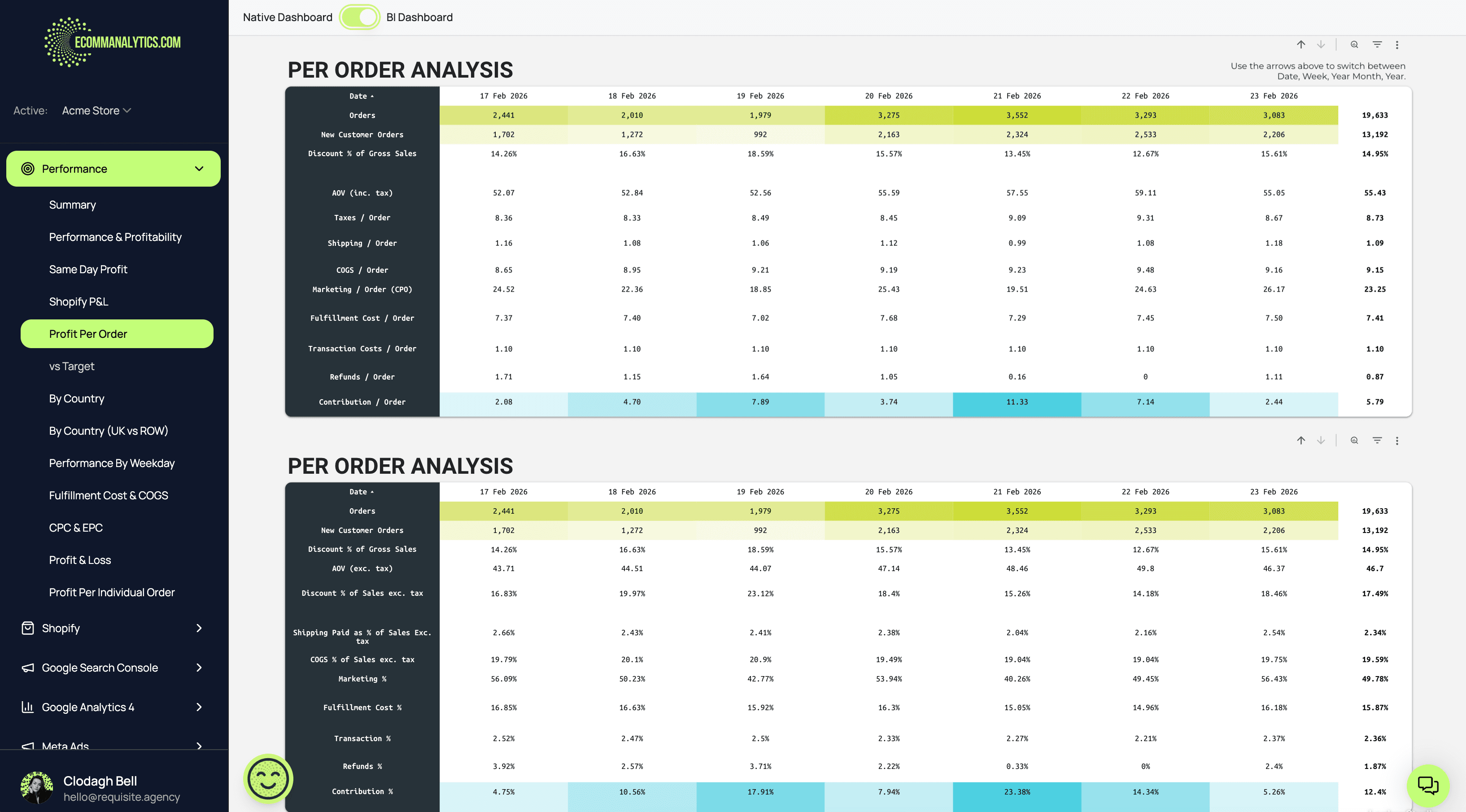
How to Calculate Your Target Cost Per Order
Let’s walk through a simple example.
Assume:
Average revenue per order: £100
Breakdown:
Tax: £16.67
COGS: £30
Fulfilment: £6
Payment processing: £3
Returns reserve: £5
Marketing: £25
Total variable cost per order: £85.67
Contribution per order: £14.33
(If you want a deeper breakdown of contribution logic, see our guide on Shopify contribution margin.)
Now marketing doesn’t need to target a 3x ROAS.
They need to stay below £25 cost per order.
That’s the difference.
ROAS is an output.
Allowable cost per order is a control system.
How This Changes How You Scale
When you manage by cost per order instead of ROAS:
Marketing
Knows exactly what they can afford to acquire a customer.
Scaling becomes controlled instead of emotional.
Operations
Sees when fulfilment inflation is threatening margin.
Finance
Understands how much room exists before fixed costs eat contribution.
Leadership
Stops debating “Is 2.8x okay?” and starts asking:
“Are we within allowable cost per order?”
This is the shift from channel-level thinking to business-level control.
Blended ROAS vs Target Cost Per Order
Blended ROAS | Target Costs Per Order |
|---|---|
Marketing efficiency metric | Profitability control metric |
High-level | Line-item precision |
Reactive | Predictive |
Channel-focused | P&L-focused |
Blended ROAS is useful.
But it should sit within a cost structure framework.
Not replace it.
Why Most Brands Don’t Do This
Because:
Shopify doesn’t show cost per order by line item
Ad platforms optimise to ROAS, not contribution
Spreadsheets break at scale
Data isn’t structured across systems
To manage profitability this way, you need structured data across revenue, marketing, fulfilment and finance.
Not disconnected spreadsheets.
Final Thoughts
Blended ROAS is not a strategy.
It’s a snapshot.
If you don’t know your allowable cost per order for each variable P&L line item, your ROAS target is guesswork.
And guesswork does not scale.
If you want to see what cost-per-order control looks like when your data is structured properly across your Shopify store, book a demo and we’ll walk you through it.
FAQs
1.
What is a good blended ROAS for ecommerce?
A good blended ROAS depends on your margin structure. A 3x ROAS may be profitable for one brand and unprofitable for another. Profitability depends on allowable cost per order and total variable costs.
2.
What is allowable cost per order?
Allowable cost per order is the maximum amount you can spend to acquire a customer while maintaining your target contribution margin. It is derived from revenue per order minus all other variable costs.
3.
Why doesn’t ROAS equal profitability?
ROAS measures revenue generated from advertising spend. It does not account for fulfilment, payment processing, returns, discounts or fixed costs. A strong ROAS can still result in weak profitability if other costs increase.
3.
How do you calculate target CPA from margin?
Your target CPA for marketing spend should be calculated from your fuel profit - which is how much remaining profit you have left, after your tax, cost of goods, fulfillment cost and payment processing cost. This is how much contribution you have left to "play with" when it comes to marketing spend.